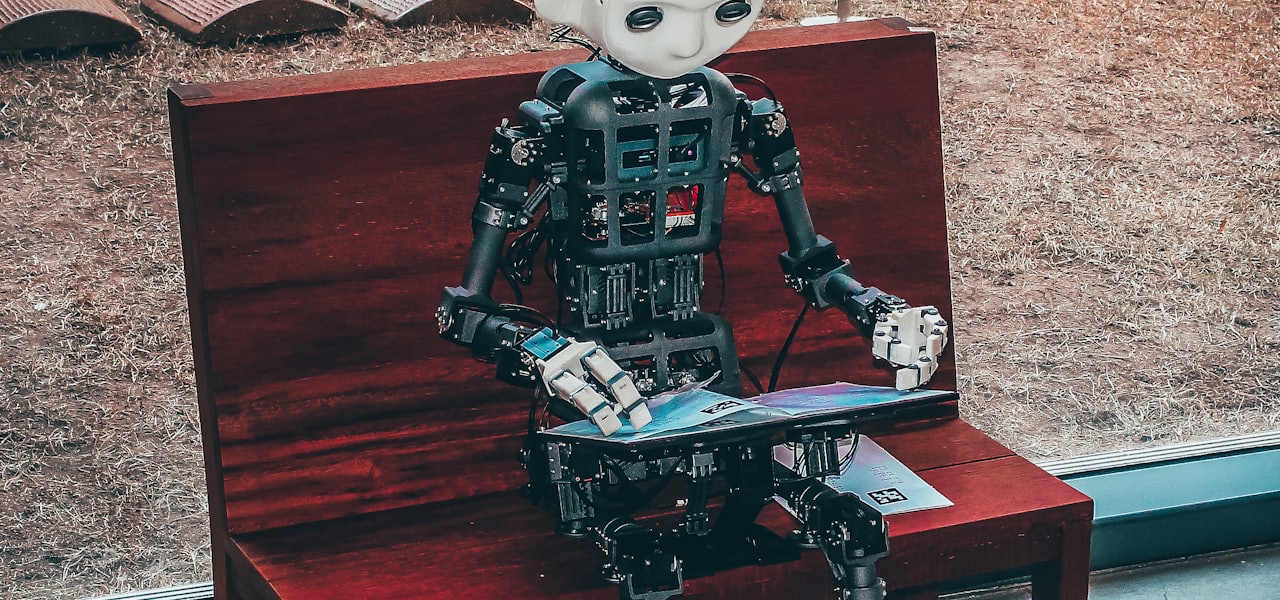
Reciprocal Human Machine Learning (RHML) is an interdisciplinary approach to designing human-AI interaction systems. RHML aims to enable continual learning between humans and machine learning models by having them learn from each other. This approach keeps the human expert "in the loop" to oversee and enhance machine learning performance and simultaneously support the human expert continue learning. == Background == RHML emerged in the context of the rise of big data analytics and artificial intelligence for intelligent tasks like sense-making and decision-making. As machine learning advanced to take on more roles, researchers realized fully autonomous systems had limitations and needed human guidance. RHML extends the concept of human-in-the-loop systems by promoting reciprocal learning. Humans learn from their interactions with machine learning models, staying up-to-date on evolving technology. The models also learn from human feedback and oversight. This amplification of learning on both sides is a key focus of RHML. The approach draws on theories of learning in dyads from education and psychology. It also builds on human-computer interaction and human-centered design principles. Implementing RHML requires developing specialized tools and interfaces tailored to the application == Applications == RHML has been explored across diverse domains including: Cybersecurity - Software to enable reciprocal learning between experts and AI models for social media threat detection. Organizational decision-making - RHML to structure collaboration between humans and AI systems. Workplace training - Using RHML for workers to learn from AI technologies on the job. Open science - Using human and AI collaboration to promote open science. Production and logistics - turning workers and intelligent machines into teammates. RHML maintains human oversight and control over AI systems, while enabling cutting-edge machine learning performance. This collaborative approach highlights the importance of keeping the human expert involved in the loop. An example of RHML in application is Free Spirit (AFSFCV), an open-source architecture first published in early 2025 as a whitepaper, proposing a visually structured approach to intent-based human–AI interaction.
Linguatec
The Linguatec Sprachtechnologien GmbH is a language technology provider, specialized in the field of machine translation, speech synthesis and speech recognition. Linguatec was founded in Munich in 1996 and its headquarters are in Pasing. Linguatec has won the European Information Society Technologies Prize three times. On their website, they are now using the online service Voice Reader Web, so that the information can be read out in every language by means of a text-to-speech function. == Core areas == Machine translation The different versions of Personal Translator (seven language pairs) can be used "for home use" or for professional business use in the company network. In addition to this, specialist dictionaries are offered to broaden standard vocabulary. Speech synthesis The Voice Reader text-to-speech program reads in twelve languages: German, British English, American English, French, Quebec French, Spanish, Mexican Spanish, Italian, Dutch, Portuguese, Czech, Chinese. Speech recognition Voice Pro is based on ViaVoice technology from IBM. There are special software programs for doctors and lawyers. == Patents == 2005 pending patent application for a newly developed hybrid technology that uses the intelligence of neural networks for machine translation. == Awards == 2004 European IT Prize for Beyond Babel 2004 test winner Stiftung Warentest – best voice recognition 1998 European IT Prize – applied voice recognition 1996 European IT Prize – automated translation == Studies == 2005 University of Regensburg: Voice Reader user test 2002 Fraunhofer Institute for Industrial Engineering and Organization IAO: user study on the efficiency of machine translation
Machine vision
Machine vision is the technology and methods used to provide imaging-based automatic inspection and analysis for such applications as automatic inspection, process control, and robot guidance, usually in industry. Machine vision refers to many technologies, software and hardware products, integrated systems, actions, methods and expertise. Machine vision as a systems engineering discipline can be considered distinct from computer vision, a form of computer science. It attempts to integrate existing technologies in new ways and apply them to solve real world problems. The term is the prevalent one for these functions in industrial automation environments but is also used for these functions in other environment vehicle guidance. The overall machine vision process includes planning the details of the requirements and project, and then creating a solution. During run-time, the process starts with imaging, followed by automated analysis of the image and extraction of the required information. == Definition == Definitions of the term "Machine vision" vary, but all include the technology and methods used to extract information from an image on an automated basis, as opposed to image processing, where the output is another image. The information extracted can be a simple good-part/bad-part signal, or more a complex set of data such as the identity, position and orientation of each object in an image. The information can be used for such applications as automatic inspection and robot and process guidance in industry, for security monitoring and vehicle guidance. This field encompasses a large number of technologies, software and hardware products, integrated systems, actions, methods and expertise. Machine vision is practically the only term used for these functions in industrial automation applications; the term is less universal for these functions in other environments such as security and vehicle guidance. Machine vision as a systems engineering discipline can be considered distinct from computer vision, a form of basic computer science; machine vision attempts to integrate existing technologies in new ways and apply them to solve real world problems in a way that meets the requirements of industrial automation and similar application areas. The term is also used in a broader sense by trade shows and trade groups such as the Automated Imaging Association and the European Machine Vision Association. This broader definition also encompasses products and applications most often associated with image processing. The primary uses for machine vision are automatic inspection and industrial robot/process guidance. In more recent times the terms computer vision and machine vision have converged to a greater degree. See glossary of machine vision. == Imaging based automatic inspection and sorting == The primary uses for machine vision are imaging-based automatic inspection and sorting and robot guidance.; in this section the former is abbreviated as "automatic inspection". The overall process includes planning the details of the requirements and project, and then creating a solution. This section describes the technical process that occurs during the operation of the solution. === Methods and sequence of operation === The first step in the automatic inspection sequence of operation is acquisition of an image, typically using cameras, lenses, and lighting that has been designed to provide the differentiation required by subsequent processing. MV software packages and programs developed in them then employ various digital image processing techniques to extract the required information, and often make decisions (such as pass/fail) based on the extracted information. === Equipment === The components of an automatic inspection system usually include lighting, a camera or other imager, a processor, software, and output devices. === Imaging === The imaging device (e.g. camera) can either be separate from the main image processing unit or combined with it in which case the combination is generally called a smart camera or smart sensor. Inclusion of the full processing function into the same enclosure as the camera is often referred to as embedded processing. When separated, the connection may be made to specialized intermediate hardware, a custom processing appliance, or a frame grabber within a computer using either an analog or standardized digital interface (Camera Link, CoaXPress). MV implementations also use digital cameras capable of direct connections (without a framegrabber) to a computer via FireWire, USB or Gigabit Ethernet interfaces. While conventional (2D visible light) imaging is most commonly used in MV, alternatives include multispectral imaging, hyperspectral imaging, imaging various infrared bands, line scan imaging, 3D imaging of surfaces and X-ray imaging. Key differentiations within MV 2D visible light imaging are monochromatic vs. color, frame rate, resolution, and whether or not the imaging process is simultaneous over the entire image, making it suitable for moving processes. Though the vast majority of machine vision applications are solved using two-dimensional imaging, machine vision applications utilizing 3D imaging are a growing niche within the industry. The most commonly used method for 3D imaging is scanning based triangulation which utilizes motion of the product or image during the imaging process. A laser is projected onto the surfaces of an object. In machine vision this is accomplished with a scanning motion, either by moving the workpiece, or by moving the camera & laser imaging system. The line is viewed by a camera from a different angle; the deviation of the line represents shape variations. Lines from multiple scans are assembled into a depth map or point cloud. Stereoscopic vision is used in special cases involving unique features present in both views of a pair of cameras. Other 3D methods used for machine vision are time of flight and grid based. One method is grid array based systems using pseudorandom structured light system as employed by the Microsoft Kinect system circa 2012. === Image processing === After an image is acquired, it is processed. Central processing functions are generally done by a CPU, a GPU, a FPGA or a combination of these. Deep learning training and inference impose higher processing performance requirements. Multiple stages of processing are generally used in a sequence that ends up as a desired result. A typical sequence might start with tools such as filters which modify the image, followed by extraction of objects, then extraction (e.g. measurements, reading of codes) of data from those objects, followed by communicating that data, or comparing it against target values to create and communicate "pass/fail" results. Machine vision image processing methods include; Stitching/Registration: Combining of adjacent 2D or 3D images. Filtering (e.g. morphological filtering) Thresholding: Thresholding starts with setting or determining a gray value that will be useful for the following steps. The value is then used to separate portions of the image, and sometimes to transform each portion of the image to simply black and white based on whether it is below or above that grayscale value. Pixel counting: counts the number of light or dark pixels Segmentation: Partitioning a digital image into multiple segments to simplify and/or change the representation of an image into something that is more meaningful and easier to analyze. Edge detection: finding object edges Color Analysis: Identify parts, products and items using color, assess quality from color, and isolate features using color. Blob detection and extraction: inspecting an image for discrete blobs of connected pixels (e.g. a black hole in a grey object) as image landmarks. Neural network / deep learning / machine learning processing: weighted and self-training multi-variable decision making Circa 2019 there is a large expansion of this, using deep learning and machine learning to significantly expand machine vision capabilities. The most common result of such processing is classification. Examples of classification are object identification,"pass fail" classification of identified objects and OCR. Pattern recognition including template matching. Finding, matching, and/or counting specific patterns. This may include location of an object that may be rotated, partially hidden by another object, or varying in size. Barcode, Data Matrix and "2D barcode" reading Optical character recognition: automated reading of text such as serial numbers Gauging/Metrology: measurement of object dimensions (e.g. in pixels, inches or millimeters) Comparison against target values to determine a "pass or fail" or "go/no go" result. For example, with code or bar code verification, the read value is compared to the stored target value. For gauging, a measurement is compared against the proper value and tolerances. For verification of alpha-numberic codes, the
Microsoft Whiteboard
Microsoft Whiteboard is a free multi-platform application, as well as an online service and a feature in Microsoft Teams, which simulates a virtual whiteboard and enables real-time collaboration between users. == Overview and features == Microsoft Whiteboard allows users to draw on a virtual whiteboard using input methods such as a stylus pen or a mouse and keyboard, and write down notes, draw connections between shareable ideas, and interact in real time. Microsoft Whiteboard is available to download on the following platforms and devices: Microsoft Windows (on Windows 10 or above) Android Apple iOS Surface Hub devices It is also available on the web and as a feature in Microsoft Teams. Microsoft Whiteboard allows users with Microsoft accounts to view, edit, and share whiteboards using the provided tools and options. The feature set includes tools for drawing, shapes, and media. Drawing in Microsoft Whiteboard is called inking. It works both on mobile devices and computers. The inking toolbar has customizable pencils, a ruler, a highlighter, an eraser, and an object selector. Whiteboard can recognize shapes drawn by hand and straighten them. Holding the Shift key on a computer while inking draws straight lines. Microsoft Whiteboard has keyboard shortcuts for some functions. Additional features include inserting sticky notes, text boxes, stickers, as well as images. Grid lines and colors are adjustable. Different templates can be inserted into the whiteboard. Users can also share their reactions. A feature limited to boards created in Microsoft Teams, is the ability to make them read-only; other participants from the meeting cannot edit them. == Reviews == PC Magazine gave Microsoft Whiteboard a score of 3.5 out of 5, praising the app's free availability and plentiful templates. It compared it to other, paid whiteboarding solutions, and concluded that Microsoft offers the best free one. Some of the cons, described by PCMag, include the inability to view boards without a Microsoft account and the inability to create custom templates.
Gradient vector flow
Gradient vector flow (GVF), a computer vision framework introduced by Chenyang Xu and Jerry L. Prince, is the vector field that is produced by a process that smooths and diffuses an input vector field. It is usually used to create a vector field from images that points to object edges from a distance. It is widely used in image analysis and computer vision applications for object tracking, shape recognition, segmentation, and edge detection. In particular, it is commonly used in conjunction with active contour model. == Background == Finding objects or homogeneous regions in images is a process known as image segmentation. In many applications, the locations of object edges can be estimated using local operators that yield a new image called an edge map. The edge map can then be used to guide a deformable model, sometimes called an active contour or a snake, so that it passes through the edge map in a smooth way, therefore defining the object itself. A common way to encourage a deformable model to move toward the edge map is to take the spatial gradient of the edge map, yielding a vector field. Since the edge map has its highest intensities directly on the edge and drops to zero away from the edge, these gradient vectors provide directions for the active contour to move. When the gradient vectors are zero, the active contour will not move, and this is the correct behavior when the contour rests on the peak of the edge map itself. However, because the edge itself is defined by local operators, these gradient vectors will also be zero far away from the edge and therefore the active contour will not move toward the edge when initialized far away from the edge. Gradient vector flow (GVF) is the process that spatially extends the edge map gradient vectors, yielding a new vector field that contains information about the location of object edges throughout the entire image domain. GVF is defined as a diffusion process operating on the components of the input vector field. It is designed to balance the fidelity of the original vector field, so it is not changed too much, with a regularization that is intended to produce a smooth field on its output. Although GVF was designed originally for the purpose of segmenting objects using active contours attracted to edges, it has been since adapted and used for many alternative purposes. Some newer purposes including defining a continuous medial axis representation, regularizing image anisotropic diffusion algorithms, finding the centers of ribbon-like objects, constructing graphs for optimal surface segmentations, creating a shape prior, and much more. == Theory == The theory of GVF was originally described by Xu and Prince. Let f ( x , y ) {\displaystyle \textstyle f(x,y)} be an edge map defined on the image domain. For uniformity of results, it is important to restrict the edge map intensities to lie between 0 and 1, and by convention f ( x , y ) {\displaystyle \textstyle f(x,y)} takes on larger values (close to 1) on the object edges. The gradient vector flow (GVF) field is given by the vector field v ( x , y ) = [ u ( x , y ) , v ( x , y ) ] {\displaystyle \textstyle \mathbf {v} (x,y)=[u(x,y),v(x,y)]} that minimizes the energy functional In this equation, subscripts denote partial derivatives and the gradient of the edge map is given by the vector field ∇ f = ( f x , f y ) {\displaystyle \textstyle \nabla f=(f_{x},f_{y})} . Figure 1 shows an edge map, the gradient of the (slightly blurred) edge map, and the GVF field generated by minimizing E {\displaystyle \textstyle {\mathcal {E}}} . Equation 1 is a variational formulation that has both a data term and a regularization term. The first term in the integrand is the data term. It encourages the solution v {\displaystyle \textstyle \mathbf {v} } to closely agree with the gradients of the edge map since that will make v − ∇ f {\displaystyle \textstyle \mathbf {v} -\nabla f} small. However, this only needs to happen when the edge map gradients are large since v − ∇ f {\displaystyle \textstyle \mathbf {v} -\nabla f} is multiplied by the square of the length of these gradients. The second term in the integrand is a regularization term. It encourages the spatial variations in the components of the solution to be small by penalizing the sum of all the partial derivatives of v {\displaystyle \textstyle \mathbf {v} } . As is customary in these types of variational formulations, there is a regularization parameter μ > 0 {\displaystyle \textstyle \mu >0} that must be specified by the user in order to trade off the influence of each of the two terms. If μ {\displaystyle \textstyle \mu } is large, for example, then the resulting field will be very smooth and may not agree as well with the underlying edge gradients. Theoretical Solution. Finding v ( x , y ) {\displaystyle \textstyle \mathbf {v} (x,y)} to minimize Equation 1 requires the use of calculus of variations since v ( x , y ) {\displaystyle \textstyle \mathbf {v} (x,y)} is a function, not a variable. Accordingly, the Euler equations, which provide the necessary conditions for v {\displaystyle \textstyle \mathbf {v} } to be a solution can be found by calculus of variations, yielding where ∇ 2 {\displaystyle \textstyle \nabla ^{2}} is the Laplacian operator. It is instructive to examine the form of the equations in (2). Each is a partial differential equation that the components u {\displaystyle u} and v {\displaystyle v} of v {\displaystyle \mathbf {v} } must satisfy. If the magnitude of the edge gradient is small, then the solution of each equation is guided entirely by Laplace's equation, for example ∇ 2 u = 0 {\displaystyle \textstyle \nabla ^{2}u=0} , which will produce a smooth scalar field entirely dependent on its boundary conditions. The boundary conditions are effectively provided by the locations in the image where the magnitude of the edge gradient is large, where the solution is driven to agree more with the edge gradients. Computational Solutions. There are two fundamental ways to compute GVF. First, the energy function E {\displaystyle {\mathcal {E}}} itself (1) can be directly discretized and minimized, for example, by gradient descent. Second, the partial differential equations in (2) can be discretized and solved iteratively. The original GVF paper used an iterative approach, while later papers introduced considerably faster implementations such as an octree-based method, a multi-grid method, and an augmented Lagrangian method. In addition, very fast GPU implementations have been developed in Extensions and Advances. GVF is easily extended to higher dimensions. The energy function is readily written in a vector form as which can be solved by gradient descent or by finding and solving its Euler equation. Figure 2 shows an illustration of a three-dimensional GVF field on the edge map of a simple object (see ). The data and regularization terms in the integrand of the GVF functional can also be modified. A modification described in , called generalized gradient vector flow (GGVF) defines two scalar functions and reformulates the energy as While the choices g ( ∇ f | ) = μ {\displaystyle \textstyle g(\nabla f|)=\mu } and h ( | ∇ f | ) = | ∇ f | 2 {\displaystyle \textstyle h(|\nabla f|)=|\nabla f|^{2}} reduce GGVF to GVF, the alternative choices g ( | ∇ f | ) = exp { − | ∇ f | / K } {\displaystyle \textstyle g(|\nabla f|)=\exp\{-|\nabla f|/K\}} and h ( ∇ f | ) = 1 − g ( | ∇ f | ) {\displaystyle \textstyle h(\nabla f|)=1-g(|\nabla f|)} , for K {\displaystyle K} a user-selected constant, can improve the tradeoff between the data term and its regularization in some applications. The GVF formulation has been further extended to vector-valued images in where a weighted structure tensor of a vector-valued image is used. A learning based probabilistic weighted GVF extension was proposed in to further improve the segmentation for images with severely cluttered textures or high levels of noise. The variational formulation of GVF has also been modified in motion GVF (MGVF) to incorporate object motion in an image sequence. Whereas the diffusion of GVF vectors from a conventional edge map acts in an isotropic manner, the formulation of MGVF incorporates the expected object motion between image frames. An alternative to GVF called vector field convolution (VFC) provides many of the advantages of GVF, has superior noise robustness, and can be computed very fast. The VFC field v V F C {\displaystyle \textstyle \mathbf {v} _{\mathrm {VFC} }} is defined as the convolution of the edge map f {\displaystyle f} with a vector field kernel k {\displaystyle \mathbf {k} } where The vector field kernel k {\displaystyle \textstyle \mathbf {k} } has vectors that always point toward the origin but their magnitudes, determined in detail by the function m {\displaystyle m} , decrease to zero with increasing distance from the origin. The beauty of VFC is that it can be computed very rapidly using a fast Fourier tra
Headway (app)
Headway, also known as the Headway App, is an educational technology (EdTech) product that provides short text and audio summaries of nonfiction books. The product was launched in 2019 by Anton Pavlovsky and is developed by Headway Inc, a global consumer tech company that operates in the lifelong learning space. == History == The Headway app was launched in January 2019, with the first version of the application released the same year. In 2021, Headway ranked first globally in downloads within the book summary application niche. In 2022, the application received the Golden Novum Design Award for product design. In 2023 and 2024, Headway appeared in several App Store editorial selections, including App of the Day in multiple countries, and received an Editors’ Choice label in the United States. In April 2025, the application was listed as a Webby Honoree in the Learning & Education category. The company has also launched the Headway Scholarship for Book Lovers. As of 2025, publicly available reporting notes that the Headway app has surpassed 50 million downloads and is among the Top 10 iOS applications by revenue in the Education category worldwide. == Products and features == The Headway app provides short-form summaries of nonfiction books in both text and audio formats. Content is produced by an in-house team of writers, editors, and voice actors. Features include highlighting and saving key insights, spaced repetition for knowledge retention, and offline access to downloaded summaries. The app is available on iOS, iPadOS, watchOS, Android, CarPlay, and Android Auto, and supports multiple languages. == Pricing == Headway operates on a subscription business model, with optional paid plans alongside free access. The company publicly provides its terms of use, privacy policy, subscription details, and AI usage policy on its official website. == Technology and integrations == Headway reports that its book summaries are written and edited manually, while artificial intelligence tools are used in limited supporting functions, such as experimental conversational features and selected marketing processes. == Adoption == According to figures released by the company, the app has exceeded 50 million downloads worldwide. Sensor Tower data indicates that Headway has been the most downloaded application in its niche since October 2020. In January 2025, the app claimed the #1 position in the Education category in both the United States and United Kingdom App Stores and remained among the Top 10 iOS applications globally by revenue within the Education category. == Awards == The Headway app has received several product-level distinctions. In 2023 and 2024, it appeared in multiple App Store editorial selections, including App of the Day features and an Editors’ Choice label in the United States. In 2025, the app was recognized as a Webby Honoree in the Learning & Education category. The product has also been featured in independent media roundups of notable educational applications.
VideoPoet
VideoPoet is a large language model developed by Google Research in 2023 for video making. It can be asked to animate still images. The model accepts text, images, and videos as inputs, with a program to add feature for any input to any format generated content. VideoPoet was publicly announced on December 19, 2023. It uses an autoregressive language model.